One memory layer,
shared across all your agents.
Your agents keep forgetting. Lore gives them a durable, shared memory graph — so knowledge from Claude Code, Codex, OpenCode and your custom agents lives in one place, inspectable and under your control.
Works with your agents
The problem
Every agent starts from zero. Every time.
You tell your agent the same preferences, fix the same mistakes, re-explain the same project context — session after session, agent after agent.
Without shared memory
- Agent forgets your preferences next session
- Two agents repeat each other’s mistakes
- Project knowledge locked in one chat history
- Switching runtimes means starting over
- No way to see what the agent “remembered”
With Lore
- Every agent boots the same stable baseline
- Knowledge written once, recalled by all
- Memories have addresses — preferences://user
- One token connects Claude Code, Codex, your stack
- Inspect every recall before the agent trusts it
Use cases
Where shared memory pays off.
Multi-agent collaboration
Three agents, one source of truth.
A planning agent captures project decisions. A coding agent reads them before every change. A review agent checks them against new code. No one re-explains the architecture — it’s already in the graph.
core://agent + project:// → shared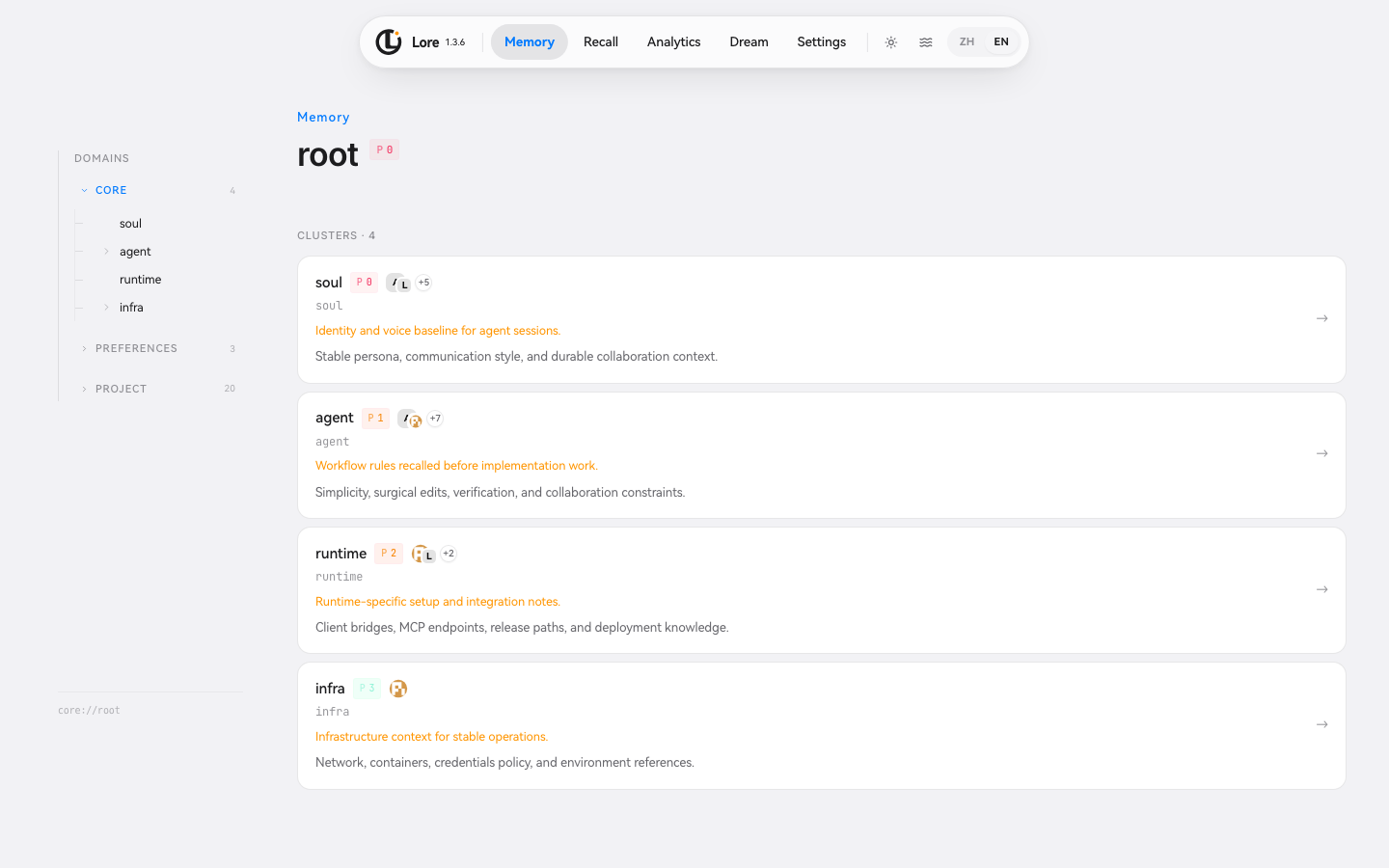
Cross-runtime
Switch tools, keep the memory.
You wrote half the project with Claude Code, now you’re in Codex. Both read the same ~/.lore baseline. Your preferences, conventions, and past decisions travel with you — not with the editor.
one token · all runtimes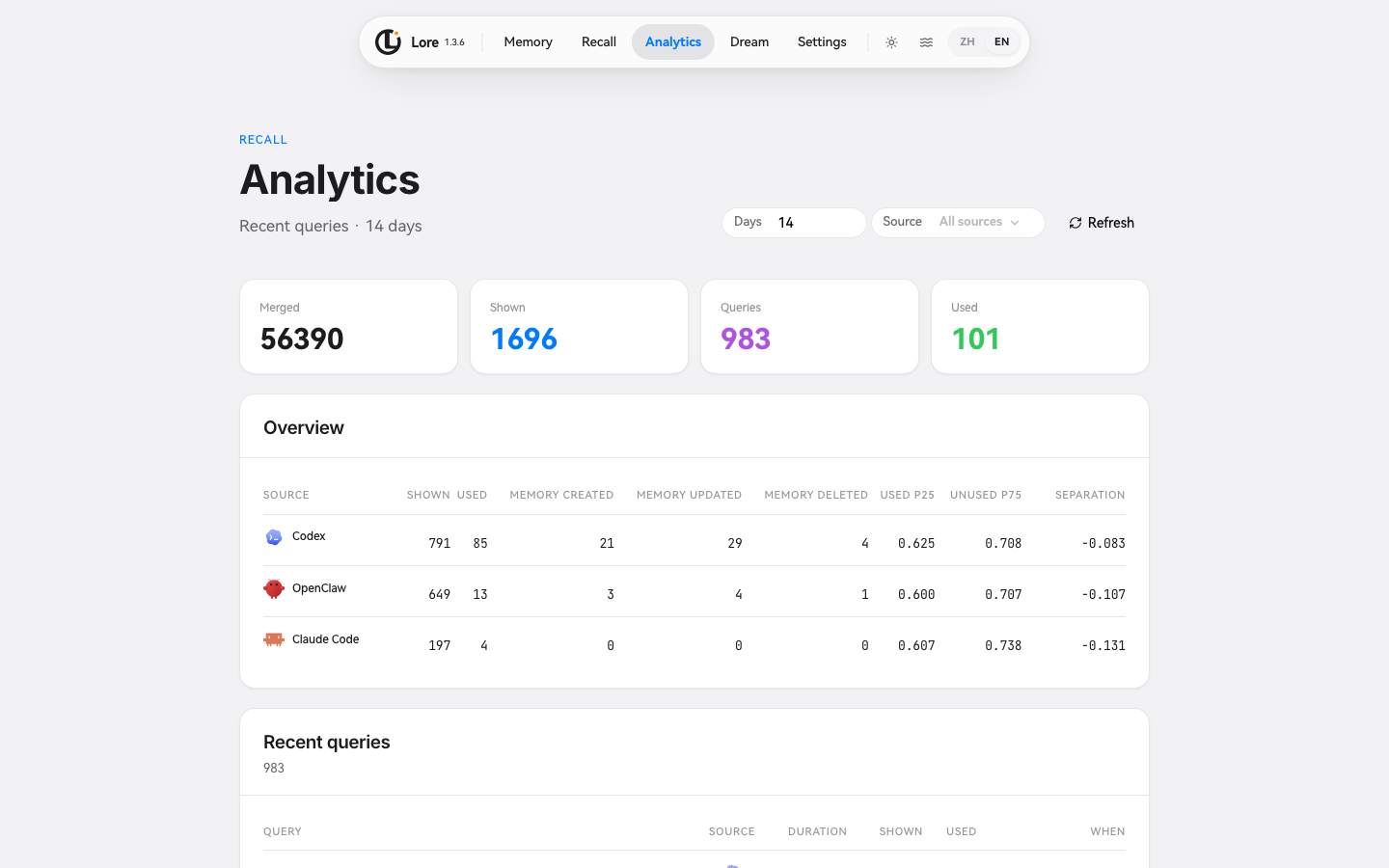
Trust & inspection
See exactly what the agent remembered.
Before every reply, Lore injects a small recall set. You can inspect which memories were considered, which were selected, and why. No black-box memory deciding things for you.
read-before-trust · rollback history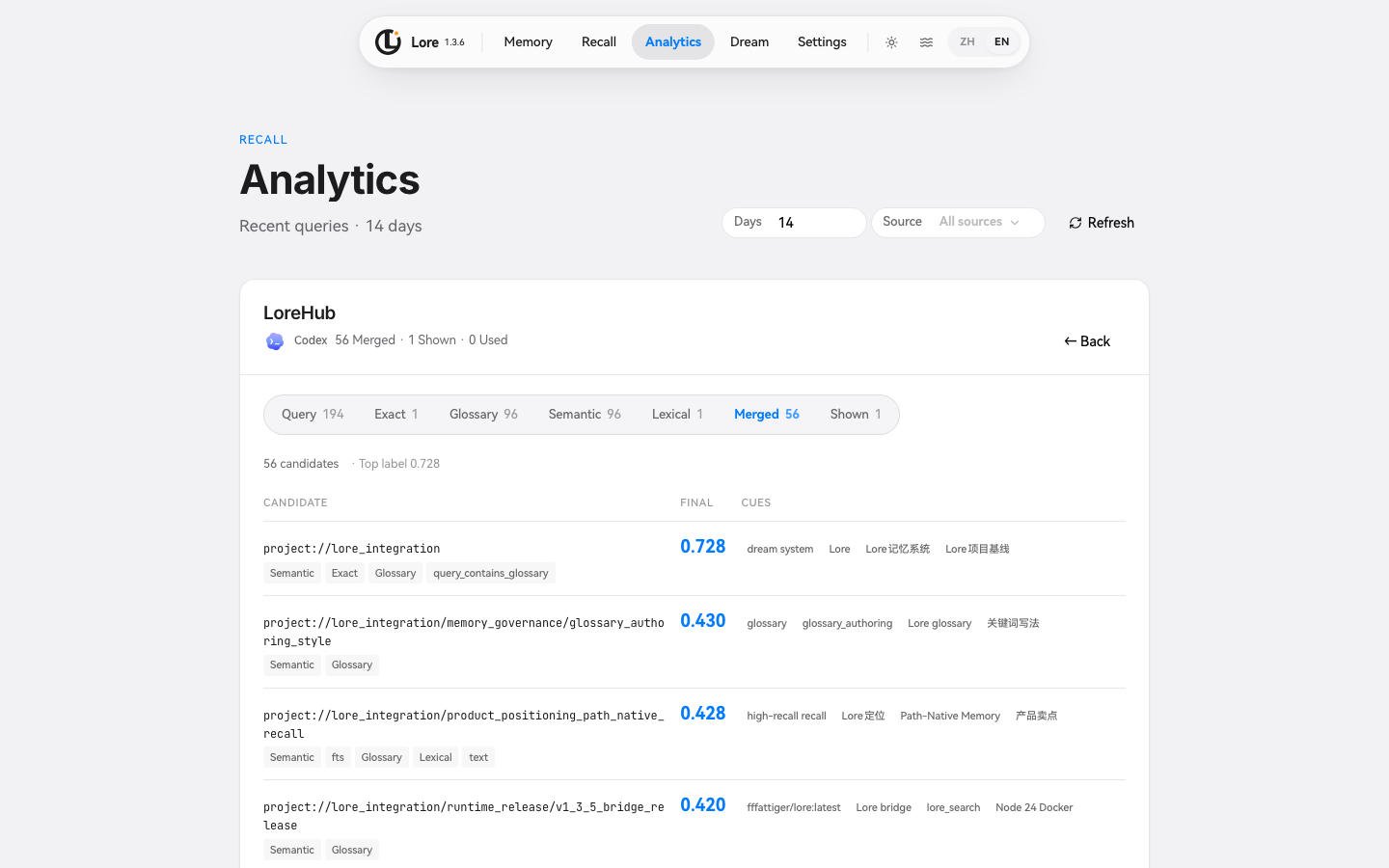
How it works
Three things happen every turn.
01 / Boot
Load the baseline
At session start, agents read stable identity, preferences, and project memory from core://, preferences://, project://.
02 / Recall
Inject before reply
Before each answer, a small <recall> set is injected — only the memories relevant to this prompt.
03 / Inspect
Read before trust
Agents open a node before relying on it. You see the full recall trace and can roll anything back.
Open source
Self-host it. Or let us run it.
Lore is MIT-licensed and runs on your machine with Docker. Prefer zero ops? Use the managed cloud and connect agents with a token.
One command to self-host
Spins up Postgres + Redis + web, connects your agent runtimes, writes config. Re-run anytime to update.



FAQ
Questions before you start.
Stop re-explaining. Start compounding.
Free to self-host. Free tier on the cloud. 5 minutes to connect your first agent.